

What Does Artificial Intelligence Means To A Business? A Practical Guide for Non-Technical Leaders
Last Updated: 23rd Jun 2026
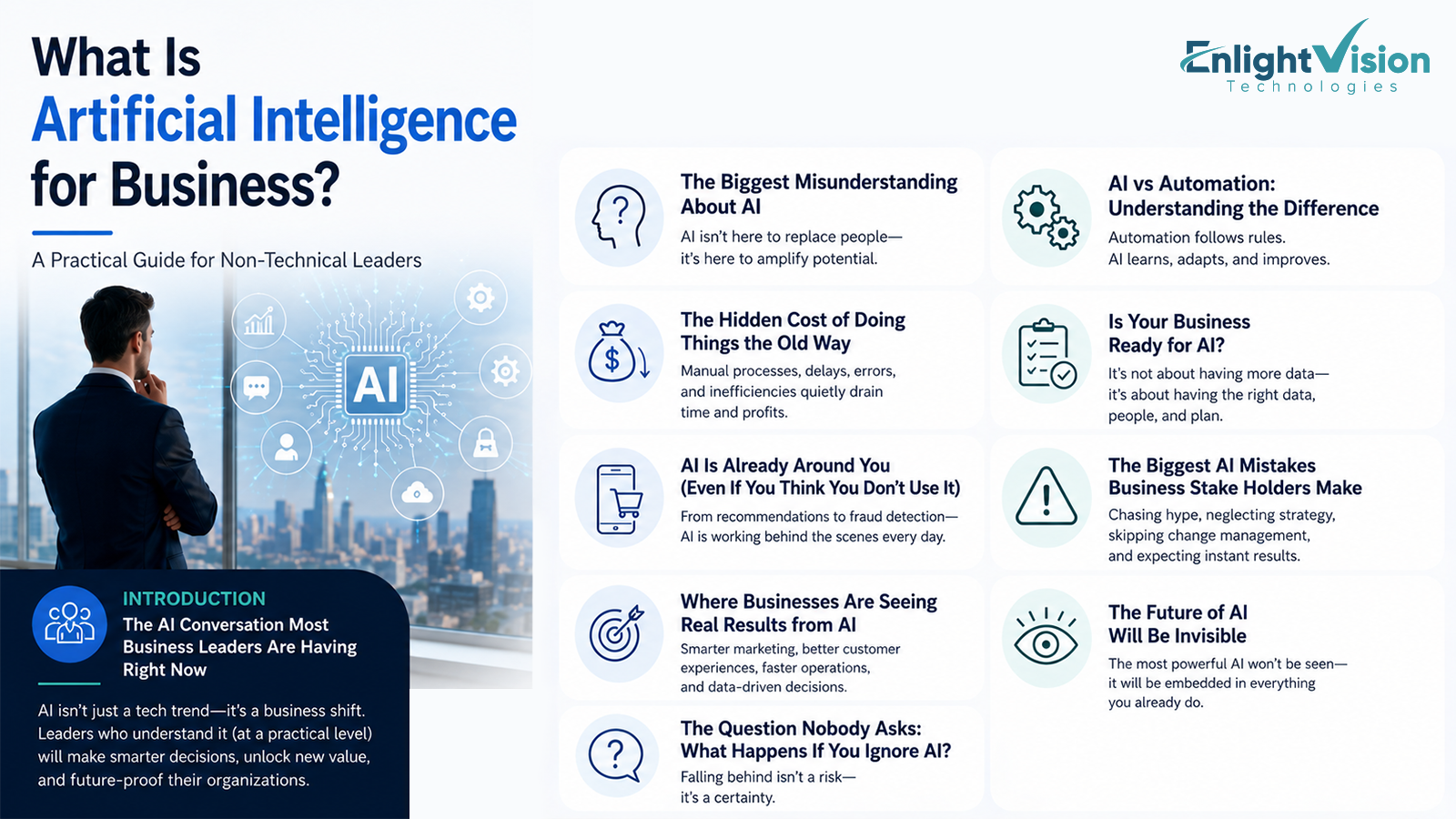
1. Introduction: The AI Conversation Most Business Leaders Are Having Right Now
Artificial Intelligence has quickly become one of the most discussed topics in business. Whether you attend an industry conference, read business news, or speak with software vendors, AI seems to be everywhere. Yet many business owners, operations managers, and executives still have one fundamental question: WHAT DOES AI ACTUALLY MEAN FOR BUSINESS?
The confusion is understandable. Most AI content focuses on technical concepts, algorithms, and complex terminology that do little to help business leaders make practical decisions. What most organizations really want to know is whether AI can save time, reduce costs, improve efficiency, or create a competitive advantage.
The good news is that AI is no longer reserved for large technology companies. Today, businesses of all sizes are using AI to streamline operations, improve decision-making, and eliminate repetitive work. Understanding how it works from a business perspective is the first step toward identifying where it can create real value.
2. The Biggest Misunderstanding About AI
2.1 AI Is Not a Technology Project – It Is a Business Improvement Tool
One of the biggest misconceptions about AI is that it is primarily a technology initiative. Many people immediately think of robots, advanced coding, or teams of data scientists working behind the scenes. In reality, most successful AI implementations begin with a business problem, not a technology decision.
For Example:
Consider a school catering business managing meal services for several schools. Staff members often spend hours reconciling food counts, reviewing allergy requirements, and preparing operational reports. By integrating AI-powered CATERING MANAGEMENT SOFTWARE FOR SCHOOL MEAL PROVIDERS, many of these repetitive activities can be automated, improving efficiency while reducing the likelihood of human error.
For Example:
Similarly, a PROFESSIONAL ACCOUNTING FIRM may use AI to categorize transactions, identify unusual spending patterns, and automate routine administrative work. The goal is not to introduce new technology for its own sake. The goal is to improve productivity and make better business decisions.
When viewed through this lens, AI becomes far less intimidating. It is simply another tool that helps businesses operate more efficiently.
3. The Hidden Cost of Doing Things the Old Way
3.1 Why Businesses Often Don’t Notice Their Biggest Operational Bottlenecks
Many organizations become accustomed to inefficient processes because they have been performing them the same way for years. Over time, these manual activities become part of daily operations and no longer attract attention.
Imagine a SCHOOL CATERING PROVIDER serving several districts. Staff members spend time every day:
- Adjusting meal counts
- Managing allergy information
- Responding to parent inquiries
- Creating monthly reports
None of these tasks seem particularly difficult. However, when these activities are repeated every day, the cumulative time investment becomes significant.
What appears to be a small administrative task may consume hundreds of hours annually. AI helps organizations identify and eliminate these hidden inefficiencies, allowing employees to focus on more valuable work.
The real cost is often not the task itself – it is the opportunity lost while employees are occupied with repetitive activities.
4. AI Is Already Around You (Even If You Think You Don’t Use It)
4.1 The Everyday Examples Most People Overlook
Many business leaders assume they have never interacted with AI. In reality, most people use AI-powered systems every day without even noticing.
When Google Maps suggests a faster route, AI is analyzing traffic patterns. When Netflix recommends a movie, AI predicts your preferences. When your email filters spam messages, AI is making decisions based on patterns it has learned over time.
These examples matter because they demonstrate that AI is not some futuristic concept. It is already embedded in everyday experiences.
Now consider how similar capabilities can be applied within a business environment. If AI can predict traffic conditions, it can also predict inventory requirements. If it can recommend movies, it can recommend products or services to customers. The underlying principle remains the same: using data to make smarter decisions.
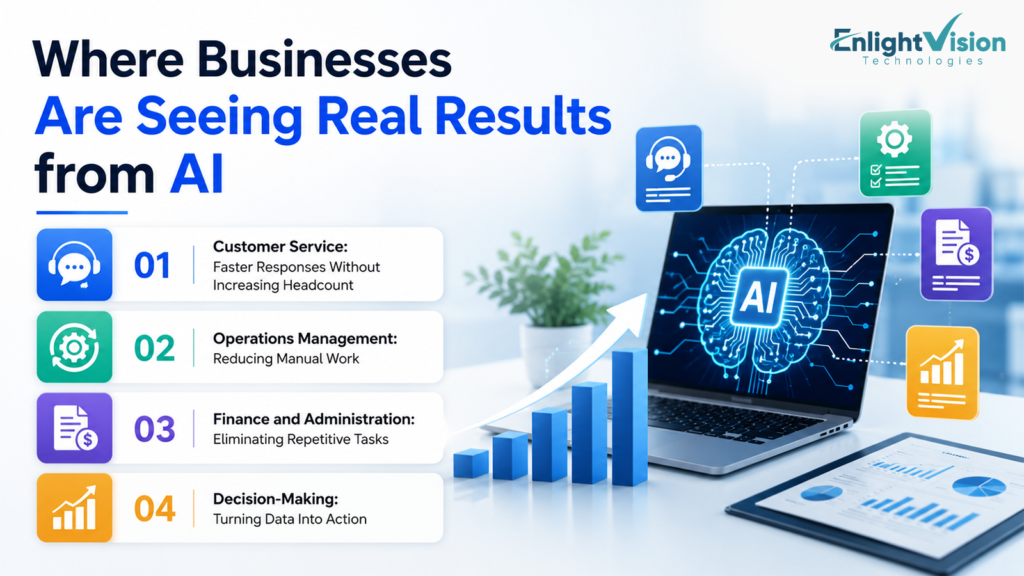
5. Where Businesses Are Seeing Real Results from AI
5.1 Customer Service: Faster Responses Without Increasing Headcount
Customer expectations continue to rise. People want quick responses, accurate information, and consistent service. AI helps organizations meet these expectations without dramatically increasing staffing costs.
For example:
A SCHOOL CATERING COMPANY may receive hundreds of inquiries regarding allergens, meal options, or billing questions. AI-powered systems can instantly answer common questions, allowing staff members to focus on more complex issues.
The result is faster service, reduced workload, and improved customer satisfaction.
5.2 Operations Management: Reducing Manual Work
Operations teams often spend significant time managing schedules, tracking resources, and coordinating workflows. AI can analyze historical patterns and automatically generate recommendations.
For Example:
A MANUFACTURING COMPANY, for example, might use AI to predict maintenance requirements before equipment failures occur. Instead of reacting to breakdowns, the organization can address issues proactively.
For Example:
Likewise, A CATERING BUSINESS can use AI to forecast meal demand based on historical ordering patterns, reducing food waste and improving inventory planning.
5.3 Finance and Administration: Eliminating Repetitive Tasks
Finance departments are filled with routine processes that follow predictable patterns. AI can automate many of these activities while maintaining accuracy.
For Example:
A CPA FIRM may use AI to categorize expenses, identify anomalies, and generate financial summaries. Rather than spending hours reviewing transactions manually, accountants can focus on strategic advisory services that create greater value for clients.
This shift allows organizations to improve efficiency without sacrificing quality.
5.4 Decision-Making: Turning Data Into Action
One of the most powerful applications of AI is helping leaders make better decisions.
Many organizations collect large amounts of data but struggle to convert it into meaningful insights. AI can identify trends, highlight anomalies, and reveal patterns that would otherwise remain hidden.
For Example:
A RETAIL BUSINESS may discover that certain products consistently perform better during specific periods of the year. AI can identify these trends automatically, helping management optimize inventory and marketing strategies.
The goal is not to replace decision-makers. It is to provide them with better information.
6. The Question Nobody Asks: What Happens If You Ignore AI?
6.1 The Cost of Waiting Too Long
Most discussions about AI focus on implementation. Few discuss the consequences of delaying adoption.
Think back to the early days of cloud computing. Many businesses questioned whether they really needed cloud-based software. Today, cloud platforms are considered standard business infrastructure.
AI may follow a similar path.
The biggest risk is not necessarily adopting AI too early. The bigger risk may be allowing competitors to become more efficient while your organization continues relying on manual processes.
Businesses that leverage AI effectively often gain advantages in speed, efficiency, and decision-making. Over time, these advantages can become difficult to overcome.
7. AI vs Automation: Understanding the Difference
7.1 Why These Terms Are Often Confused
Many people use AI and automation interchangeably, but they are not the same thing.
Automation follows predefined rules.
For Example:
A system that automatically sends an Invoice Reminder after seven days is performing automation. AI goes a step further.
An AI-powered system might predict Which Customers Are Likely To Pay Late before the invoice is even overdue, Allowing The Business To Take Proactive Action.
UNDERSTANDING THIS DISTINCTION HELPS ORGANIZATIONS CHOOSE THE RIGHT SOLUTION FOR THE RIGHT PROBLEM.
8. Is Your Business Ready for AI?
8.1 The Signs Are Often Easier to Spot Than You Think
Many business leaders assume AI requires massive amounts of data or large technology budgets. In reality, readiness often depends on the nature of the business challenges being faced.
Your organization may be ready for AI if:
- Employees spend significant time on repetitive work
- Reports take too long to generate
- Operational mistakes are becoming costly
- Decision-making relies heavily on manual analysis
These indicators suggest opportunities where AI can create measurable value.
The objective is not to adopt AI everywhere at once. It is to identify the areas where it can deliver the greatest impact first.
9. The Biggest AI Mistakes Business Stake Holders Make
9.1 Chasing Technology Instead of Solving Problems
One of the most common mistakes organizations make is purchasing AI tools before clearly defining the problem they want to solve.
Successful AI projects begin with a business objective.
For Example:
Reducing food waste, improving customer response times, or accelerating reporting processes are clear business goals. Once the goal is established, the appropriate AI solution becomes easier to identify.
Another common misconception is that AI will replace entire teams. In reality, AI is most effective when it supports employees by removing repetitive work and allowing them to focus on higher-value activities.
Organizations that approach AI as a business improvement strategy tend to achieve far better outcomes than those that pursue it simply because it is trending.
10. The Future of AI Will Be Invisible
10.1 Why Businesses Will Eventually Stop Talking About AI
Today, companies frequently highlight their AI initiatives because the technology is still relatively new. Over time, however, AI is likely to become as commonplace as internet connectivity or cloud software.
Businesses do not advertise that they use electricity. They simply use it because it is essential.
AI may evolve in a similar way.
In the future, organizations will not ask whether they use AI. They will ask why certain processes are still manual when automation and intelligence could improve them.
The businesses that succeed will not necessarily be the most technical. They will be the ones that use technology in the most practical and effective ways.
Conclusion: Start Small, Think Practical, Focus on Outcomes
Artificial Intelligence does not have to be complicated. For most organizations, the journey begins with identifying repetitive tasks, operational bottlenecks, or decision-making challenges that consume unnecessary time and resources.
Whether You Operate A School Catering Business, A CPA Firm, A Manufacturing Company, Or A Retail Operation, AI Offers Opportunities To Improve Efficiency And Support Growth.
The most successful businesses are not adopting AI because it is fashionable. They are adopting it because it helps them save time, reduce errors, improve decision-making, and operate more effectively.
The question is no longer whether AI will impact business.
The question is how your organization can use it in a practical way to create measurable value.

Author
Mr. Bhargav Bhatt
I am the General Manager at EnlightVision Technologies, where I focus on driving operational excellence and delivering innovative IT solutions. With strong experience in the Software Industry and Project Management, I work on building scalable digital products and helping businesses achieve efficient, technology-driven growth.